Schaumburg Storm Damage IL — Commercial & Residential Emergency Triage

Immediate contractor dispatch for commercial flat roof membrane tears, retail plaza ponding leaks, and residential gale shingle blow-off across Schaumburg and the I-90 corridor.
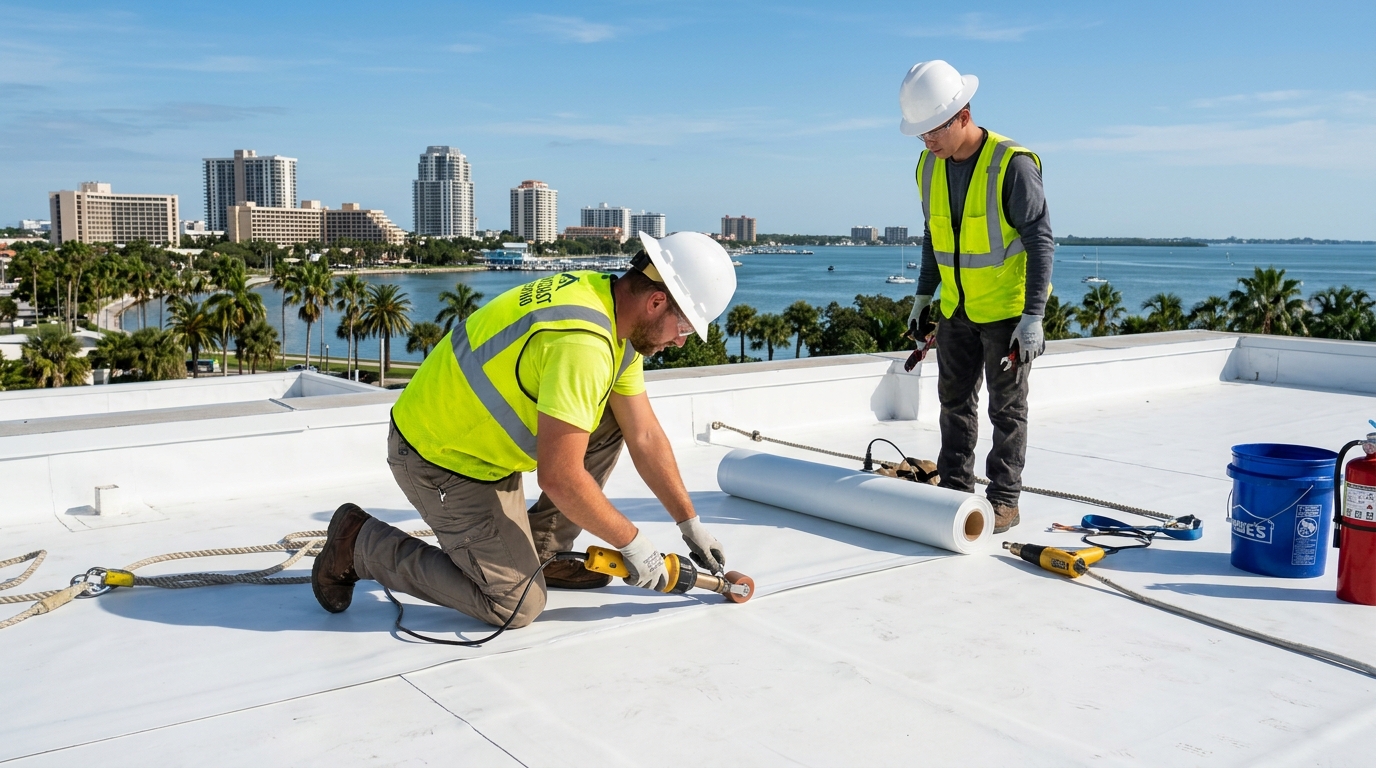
Schaumburg serves as the economic and commercial hub of Chicago’s northwest suburbs, home to expansive retail centers around Woodfield Mall, corporate office complexes along the I-90 Golden Corridor, and extensive residential subdivisions. When severe hail supercells, straight-line winds, or heavy winter precipitation hit Schaumburg, both commercial low-slope membranes and residential shingle roofs face acute water penetration risks. RoofExpertUSA dispatches independent, licensed roofing contractors across Schaumburg, Hoffman Estates, and Palatine.

Commercial & Residential Storm Exposure in Schaumburg

The northwest suburban landscape is characterized by wide-span commercial flat roofs (warehouses, retail strip centers, medical plazas) and multi-family condominium communities. High straight-line winds tearing through open highway corridors exert intense negative uplift pressure on unballasted TPO and EPDM single-ply membranes. Seams can delaminate, perimeter edge metal flashings can pull away from wood nailers, and rooftop HVAC units can vibrate and puncture roof cap sheets during heavy gusts.

In residential neighborhoods, older three-tab and architectural shingles succumb to wind uplift, exposing plywood sheathing to torrential rain. Commercial property managers and homeowners require fast, competent triage to prevent business interruptions, inventory loss, and tenant displaced living. Dispatched commercial crews deploy robotic hot-air seam welders, industrial wet-vac extraction pumps, and 10-mil timber batten tarps for rapid containment.

Schaumburg Specialized Field Protocols

Commercial TPO / PVC Hot-Air Patching

Technicians perform surgical membrane patches using Leister robotic hot-air welders, fusing 60-mil TPO or PVC sheets to restore monolithic waterproof protection across commercial low-slope roofs.

Rooftop HVAC Curb & Penetration Sealing

Vibration from heavy commercial air handling units cracks perimeter membrane flashings. Crews install reinforced elastomeric flashings and liquid-applied PMMA seals around mechanical stanchions.

Residential Timber Batten Tarping

Where storm winds strip shingles from Schaumburg homes, crews install heavy-duty 10-mil poly tarps secured with 2x4 spruce battens rafter-anchored to resist subsequent gale gusts.

Insurance Forensic Documentation

Comprehensive photographic damage packets and Haag-standard test square counts provide commercial building owners and homeowners with verified evidence for insurance claims.

Frequently Asked Questions

How fast can emergency roofing contractors arrive in Schaumburg? +

On-call crews are dispatched via I-90 and Route 53, targeting arrival within 45 to 75 minutes across Schaumburg, Hoffman Estates, Elk Grove Village, and Palatine.

Can you repair commercial flat roofs on Schaumburg retail and office buildings? +

Yes. Dispatched partner contractors hold Illinois Unlimited Licenses and deploy commercial-grade equipment for TPO, PVC, EPDM, and modified bitumen low-slope roof systems.

Do you provide emergency service outside normal business hours? +

Yes. Our direct telephone dispatch desk operates 24 hours a day, 7 days a week, 365 days a year for immediate emergency leak containment and storm mitigation.

Chicagoland Regional Technical Engineering & Flat Roof Protocols

1 Regional Microclimate Dynamics & Lake Michigan Gale / Polar Vortex Exposure

Chicago and Cook County occupy an aggressive meteorological environment driven by Lake Michigan's thermal inertia, sudden sub-zero polar vortex incursions, and intense convective summer squalls. Flat roof assemblies across classic Chicago brick 2-flats, greystones, industrial warehouses, and commercial strip centers bear extreme thermal expansion and contraction cycles. Winter temperatures plunging to -20°F cause low-slope membranes to contract and stiffen, making seams brittle.

When high gale winds whip onshore off Lake Michigan at 50 to 65+ mph, aerodynamic negative pressure (uplift) stresses roof perimeters, pulling at unballasted single-ply membranes and stripping loose asphalt shingles along windward eaves across Chicago, Evanston, and Schaumburg.

2 Non-Destructive Moisture Diagnostics & FLIR Thermal Tracing

Water intrusion on flat roofs rarely surfaces directly beneath the membrane puncture. Water enters a hairline seam breach or defective parapet wall reglet, travels horizontally across polyiso insulation boards, and pools at low decking joints before penetrating interior plaster or suspended acoustical tiles. Dispatched technicians employ calibrated FLIR infrared thermography to map hidden subsurface moisture saturation.

Because wet insulation retains absorbed solar heat far longer than dry substrate after sunset, high-resolution thermal imaging highlights saturated insulation boundaries with razor-sharp contrast, eliminating unnecessary tear-offs and pinpointing exact membrane surgical cut points.

3 Step-by-Step Modified Bitumen & Single-Ply Membrane Restoration

Long-lasting flat roof remediation follows a strict technical sequence: (1) Standing water extraction using pneumatic pump equipment and surface drying with heated air blasters; (2) Surgical excision of wet core insulation down to structural tongue-and-groove or corrugated steel decking; (3) Replacement with matching R-value closed-cell polyisocyanurate insulation fill; (4) Application of high-tensile SBS granule-surfaced cap sheet hot-air welded or torched with proper 6-inch perimeter laps, or robotic thermo-fused TPO/PVC patches exceeding 1,000°F melt bonds; (5) Application of elastomeric flashing compound around all scupper boxes and roof drains.

4 Chicago Municipal Building Code (Title 14R) & Illinois Contractor Licensing Compliance

All roofing installations within the City of Chicago must strictly comply with the Chicago Municipal Code (Title 14R - Chicago Building Rehabilitation Code) and the Illinois Roofing Industry Licensing Act (225 ILCS 320). In Illinois, contractors performing commercial or residential roofing must hold an active State of Illinois Roofing Contractor License issued by the Illinois Department of Financial and Professional Regulation (IDFPR).

Referred independent contractors carry active IDFPR Unlimited Licenses (covering low-slope commercial and steep-slope residential), maintain a minimum of ,000,000 in General Liability insurance, carry statutory Illinois Workers' Compensation, and obtain all necessary City of Chicago Department of Buildings permits for roof replacements and structural rebuilds.

5 Preventative Property Maintenance & Parapet Coping Freeze-Thaw Management

Chicago property owners must enforce proactive semi-annual roof inspections each spring and late autumn. Over 40% of flat roof leaks in Chicago brick buildings originate not from the horizontal deck, but from crumbling terra cotta or limestone parapet coping joints. Trapped summer rain within unsealed masonry freezes during December cold snaps, expanding by 9% and popping mortar joints apart.

Clear roof scupper drains, inspect sheet metal counter-flashing reglet joints, verify that eave gutters remain free of debris, and check all HVAC curb flashings before winter storm systems make emergency roof access treacherous.

CALL NOW — (888) 208‑4155